
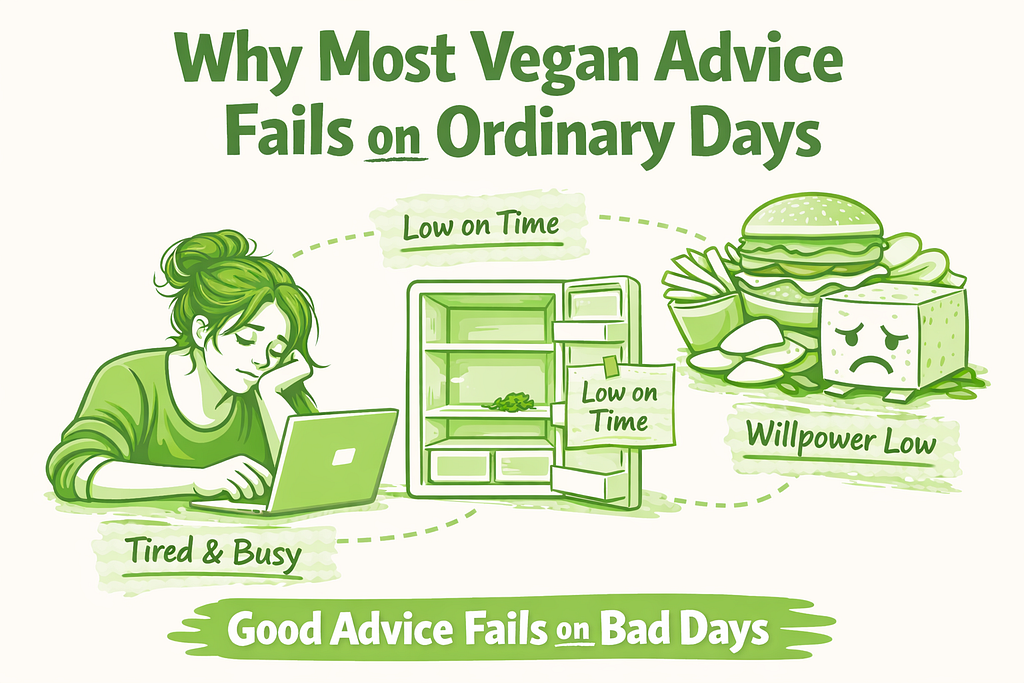
Days when you are motivated.
Days when you have time.
Days when your kitchen is stocked and your energy is high.
Those days are not the problem.
The problem is the ordinary ones.
The average weekday.
The day you slept badly.
The day work ran long.
The day you are tired, distracted, or emotionally flat.
Most advice quietly assumes those days will be handled later — with discipline, motivation, or “getting back on track.” But those days are not exceptions. They are the majority of life.
And that is where most systems break.
The Hidden Assumption Behind Most Vegan Advice
Much of vegan guidance is built on an invisible premise:
You will care enough, often enough, to keep choosing this.
So the advice focuses on:
- Better recipes
- Better planning
- Better information
- Better motivation
All useful in theory.
But none of them reduce effort on the days when effort is scarce.
The result is a system that only functions when conditions are ideal. When they are not, eating becomes heavy. Decisions multiply. Friction appears everywhere.
What should support your life starts competing with it.
Ordinary Days Don’t Respond to Ideals
On ordinary days, you are not looking to live your values perfectly.
You are looking to get through the day.
You want food that:
- Does not require thinking
- Does not create mess
- Does not invite debate with yourself
- Does not leave you feeling worse afterward
Advice built around ideals — health optimization, variety, perfection, novelty — adds pressure exactly where pressure is least sustainable.
This is not a failure of commitment.
It is a mismatch between design and reality.
Why “Try Harder” Never Works Long-Term
When people struggle to maintain vegan habits, the response is often subtle but consistent:
Plan better.
Learn more.
Care more.
But effort is not a stable resource. It fluctuates daily.
Any system that requires consistent effort will eventually fail — not because you are weak, but because life is unpredictable.
Habits last when they require less of you over time, not more.
Ordinary Days Are the Real Test
If your way of eating only works when:
- You are motivated
- You are inspired
- You have time
- You feel mentally clear
Then it is not sustainable.
Sustainability is not proven on good days.
It is proven on unremarkable ones.
A system that works on ordinary days quietly wins.
A system that only works on ideal days eventually disappears.
The Alternative: Design for Average Conditions
The solution is not intensity.
It is design.
Design that assumes:
- You will be tired sometimes
- You will repeat meals
- You will not want to decide
- You will want food to fade into the background
This means:
- Fewer choices, not more
- Familiar meals, not constant novelty
- Defaults instead of decisions
- Ease instead of optimization
When eating becomes obvious, it stops demanding attention.
And when it stops demanding attention, it becomes repeatable.
Ordinary Is Where Habits Live
Most of your life is not dramatic.
It is not transformational.
It is not optimized.
It is ordinary.
Habits that survive there are the ones that last.
Not because they are perfect.
Not because they are impressive.
But because they are easy enough to repeat when nothing special is happening.
That is where real sustainability begins — not on your best days, but on your most forgettable ones.