
“No cheese, please.”
Three words. Simple enough. And yet, the moment they leave your mouth, something shifts.
The person across from you pauses. Their eyes change. Not hostile. Just curious in a way that feels like the beginning of something you did not sign up for.
“Oh, are you vegan?”
And now you have a choice.
You can explain. You can give the short version or the long version. You can be casual about it or thorough. You can preempt follow-ups or leave room for them.
Or you can just say, “Yeah,” and move on.
Most people choose to explain. Not because they want to. Because they feel like they are supposed to.
The Invisible Obligation
Somewhere along the way, food choices became things that required justification.
Nobody asks why you ordered the pasta. Nobody needs a backstory for choosing the salad if it comes with chicken. But remove one ingredient, add one constraint, and suddenly the meal becomes a conversation.
The obligation is invisible but consistent. If your food looks different, you owe the room a reason.
Health. Ethics. Allergies. A documentary you watched. A phase you are trying.
The specific reason almost does not matter. What matters is that you offered one. That you made your choice legible. That you gave people something to file it under so the moment could resolve.
Without a reason, the choice just floats there, unexplained, and that makes people uncomfortable in a way they rarely examine.
Why We Over-Explain
The instinct to explain is not about the other person. Not really.
It is about managing discomfort. Yours and theirs.
When you explain, you are doing several things at once. You are signaling that you are reasonable. That you have thought about this. That your choice is grounded in something larger than preference. That you are not being difficult on purpose.
You are, in short, apologizing without saying sorry.
And every time you do it, you reinforce the idea that your food needs a defense.
This is exhausting on a good day. On a tired one, it turns a simple dinner into emotional labor.
The Social Cost of Long Answers
Long answers invite long conversations.
The more context you give, the more surface area you create. Every reason becomes a thread someone can pull. Health invites debate. Ethics invites challenge. Environment invites comparison.
You did not come to dinner to give a lecture or receive one. You came to eat and be with people.
But the moment food becomes a topic, it absorbs the evening. You find yourself defending, clarifying, softening. Managing someone else’s reaction to your plate.
This is not connection. It is maintenance.
And it follows you home. The quiet replay. Did I say too much? Did I sound preachy? Did I make it weird?
None of that would have happened if the answer had been shorter.
Short Answers Are Not Evasive
There is a fear that short answers seem rude. Dismissive. Like you are hiding something or shutting people down.
The opposite is true.
Short answers release the room. They let the moment pass. They signal that this is not a big deal, which gives everyone else permission to treat it the same way.
“No cheese, thanks.” “Are you vegan?” “Yeah, mostly.”
Done. The conversation continues. The food arrives. Nobody remembers what you ordered by dessert.
Short answers are not avoidance. They are a gift to the table. They keep the focus where it belongs, which is almost never on what one person chose not to eat.
The Less You Say, the Faster It Disappears
This is the part that feels counterintuitive.
Most people explain because they want to prevent awkwardness. But explanation is what sustains it. The more words you wrap around a food choice, the more it becomes an event. The less you say, the faster it fades into the background noise of a normal meal.
Think about the people you know who eat a certain way without it ever becoming a thing. They are not secretive about it. They are just brief. Their food does not carry a presentation.
They order, they eat, they talk about something else.
Nobody remembers their plate.
That invisibility is not a loss. It is the whole point.
You Have Already Earned the Right to Eat Quietly
You do not need to convince anyone. You do not need to make your plate make sense to the table. You do not need to preempt questions or prepare talking points before a dinner reservation.
You just need to eat.
The people who care about you will not require a thesis. The people who challenge you were not going to be satisfied by any answer anyway.
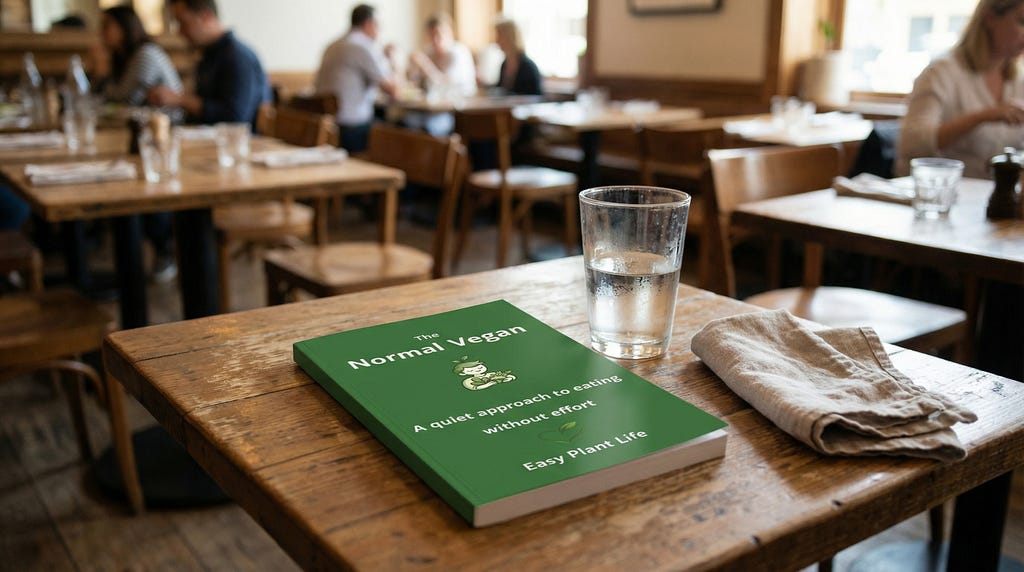
This is one of the quieter ideas in The Normal Vegan. That social friction around food is not solved by better arguments. It is solved by shorter answers. By letting your plate be boring enough that nobody thinks to ask.
When food stops being a statement, it stops inviting commentary.
And when commentary stops, dinner goes back to being dinner.
Which is all it was supposed to be.